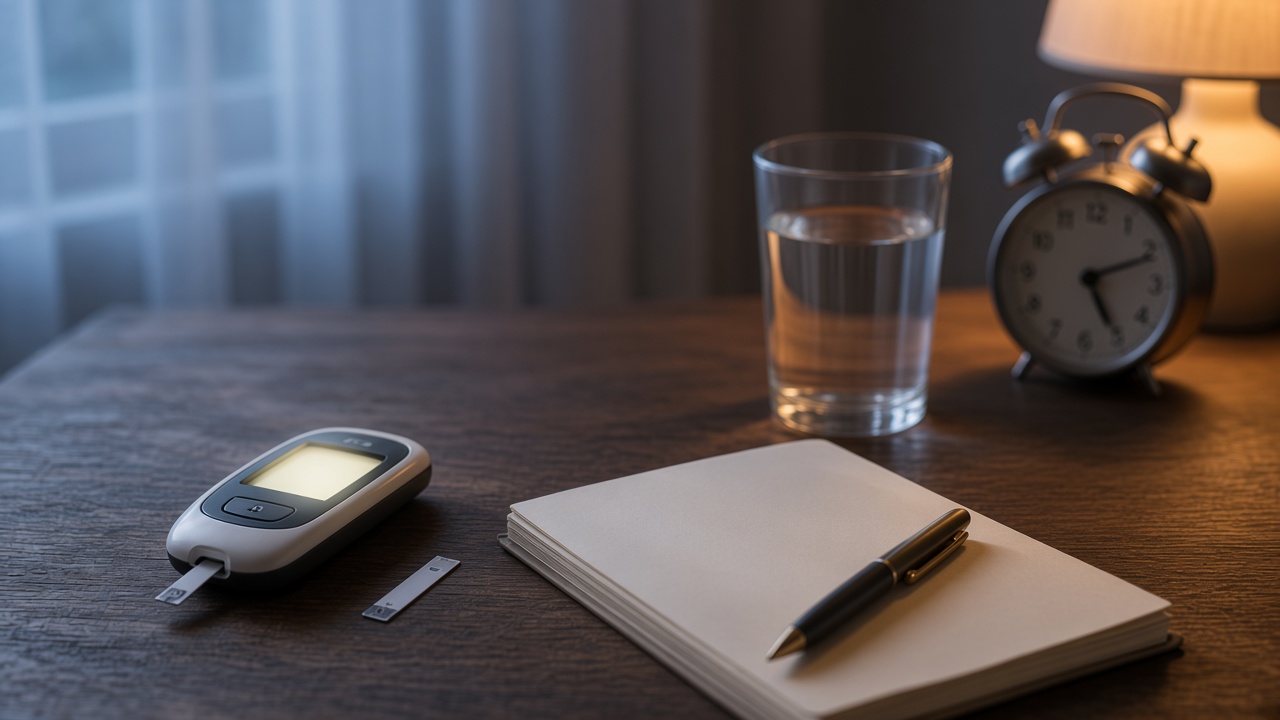
The meter beeps at 6:40 a.m. Dinner was restrained. You skipped dessert. Yet the fasting sugar sits higher than pride allows. The first instinct is guilt. The better instinct is physiology.
In the early morning — roughly between 3 and 8 a.m. — the body prepares for waking. Cortisol and growth hormone rise. The liver answers by releasing glucose into the blood. In someone without diabetes, pancreatic insulin rises quietly to match. In diabetes or insulin resistance, that match fails — and the fasting number looks like a confession you did not earn.
The American Diabetes Association’s explainer on high morning blood glucose puts it plainly: those dawn hormones signal the liver to boost glucose so you can wake up. If you do not make enough insulin — or are too resistant to it — levels are elevated when you open your eyes. That pattern is commonly called the dawn phenomenon.
Cortisol is not the villain — mismatch is
Cortisol follows a circadian arc: highest around awakening, lowest near midnight. That rhythm is adaptive. Problems appear when hepatic glucose output outruns available insulin action. Stress, poor sleep, infection, pain, and glucocorticoid medicines can amplify the morning rise. So can simply having type 2 diabetes with residual insulin resistance.
Related patterns patients confuse:
- Dawn phenomenon — early-morning rise without overnight hypoglycaemia (Cleveland Clinic overview; NCBI clinical review)
- Overnight food or late alcohol — true dietary contribution; still common, still worth asking about
- Rebound after a nocturnal low — less often than folklore suggests, but CGM can settle the argument
What a high fasting number is — and is not
It is a snapshot under hormonal influence. It is not, by itself, proof that you “cheated” at midnight. It is also not licence to ignore the plate. Morning cortisol does not cancel a carbohydrate-heavy lifestyle; it simply means we stop moralising every elevated fasting reading.
- Compare fasting trends with post-meal numbers and HbA1c — discordant patterns deserve a clinical conversation
- Ask about sleep, shift work, steroids, illness, and the timing of evening medicines
- Do not self-escalate insulin or tablets at dawn out of fear alone; unsupervised correction is how hypoglycaemia begins
Stop punishing the morning number. Interrogate the pattern.
How to investigate without panic
1. Log three mornings, not one shameful day.
One reading is weather. Three to seven fasting values show climate. Note bedtime snack, alcohol, sleep quality, and whether you felt shaky overnight.
2. Use a short CGM when the story is muddy.
A fortnight of continuous data — the habit we unpack in Part 3 — shows whether glucose climbs from 3 a.m. without a preceding low. That distinction changes management.
3. Fix the evening plate before you rewrite the prescription pad.
Late heavy rice, dessert, and grazing still matter. Diet remains make-or-break — see Part 2 — even when dawn biology is real.
4. Bring the question to clinic with context.
Age, kidney function, frailty, and hypoglycaemia risk decide how aggressively we chase fasting perfection. Older adults especially need targets that respect safety — covered in the series overview.
The clinical takeaway
Morning cortisol and the dawn rise explain why a “perfect” dinner can still meet an imperfect fasting meter. Respect the hormone. Respect the plate. Refuse unsupervised dawn bravado. Then let diet and a periodic CGM teach the rest of the day.
Your 6 a.m. sugar may be telling the truth about physiology — not about character.

This article is general educational content by Dr. Amitabh Parti. It is not a substitute for individual medical advice. Please consult a qualified physician for guidance specific to your condition.
Respond to this essay
Thoughts, questions, or a letter of your own? Dr. Parti reads correspondence at amitabhparti@gmail.com. Please do not send clinical questions or personal medical details — this is not a consultation channel.